Production
Cowboy Bebop was developed by animation studio Sunrise and created by Hajime Yatate, the well-known pseudonym for the collective contributions of Sunrise's animation staff. The leader of the series' creative team was director Shinichirō Watanabe, most notable at the time for directing Macross Plus and Mobile Suit Gundam 0083: Stardust Memory. Other leading members of Sunrise's creative team were screenwriter Keiko Nobumoto, character designer Toshihiro Kawamoto, mechanical art designer Kimitoshi Yamane, composer Yoko Kanno, and producers Masahiko Minami and Yoshiyuki Takei. Most of them had previously worked together, in addition to having credits on other popular anime titles. Nobumoto had scripted Macross Plus, Kawamoto had designed the characters for Gundam, and Kanno had composed the music for Macross Plus and The Vision of Escaflowne. Yamane had not worked with Watanabe yet, but his credits in anime included Bubblegum Crisis and The Vision of Escaflowne. Minami joined the project as he wanted to do something different from his previous work on mecha anime.Concept
Cowboy Bebop was Watanabe's first project as solo director, as he had been co-director in his previous works.[36] His original concept was for a movie, and during production he treated each episode as a miniature movie.[37][38] His main inspiration for Cowboy Bebop was Lupin III, a crime anime series focusing on the exploits of the series' titular character.[23] When developing the series' story, Watanabe began by creating the characters first. He explained, "the first image that occurred to me was one of Spike, and from there I tried to build a story around him, trying to make him cool."[36] While the original dialogue of the series was kept clean to avoid any profanities, its level of sophistication was made appropriate to adults in a criminal environment.[23] Watanabe described Cowboy Bebop as "80% serious story and 20% humorous touch".[39] The comical episodes were harder for the team to write than the serious ones, and though several events in them seemed random, they were carefully planned in advance.[31] Watanabe conceived the series' ending early on, and each episode involving Spike and Vicious was meant to foreshadow their final confrontation. Some of the staff were unhappy about this approach as a continuation of the series would be difficult. While he considered altering the ending, he eventually settled with his original idea. The reason for creating the ending was that Watanabe did not want the series to become like Star Trek, with him being tied to doing it for years.[31]Development
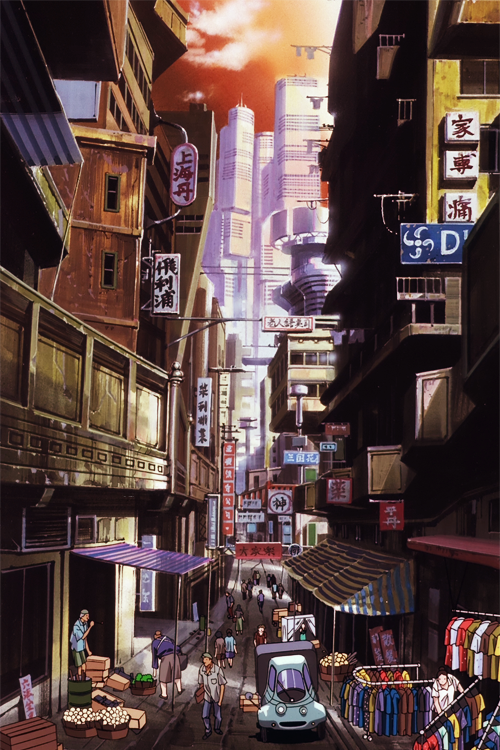
The project had initially originated with Bandai's toy division as a sponsor, with the goal of selling spacecraft toys. Watanabe recalled his only instruction was "So long as there's a spaceship in it, you can do whatever you want." But upon viewing early footage, it became clear that Watanabe's vision for the series did not match Bandai's. Believing the series would never sell toy merchandise, Bandai pulled out of the project, leaving it in development hell until sister company Bandai Visual stepped in to sponsor it. Since there was no need to merchandise toys with the property any more, Watanabe had free rein in the development of the series.[36] Watanabe wanted to design not just a space adventure series for adolescent boys but a program that would also appeal to sophisticated adults.[23] During the making of Bebop, Watanabe often attempted to rally the animation staff by telling them that the show would be something memorable up to three decades later. While some of them were doubtful of that at the time, Watanabe many years later expressed his happiness to have been proven right in retrospect. He joked that if Bandai Visual had not intervened then "you might be seeing me working the supermarket checkout counter right now."[36]The city locations were generally inspired by the cities of New York and Hong Kong.[40] The atmospheres of the planets and the ethnic groups in Cowboy Bebop mostly originated from Watanabe's ideas, with some collaboration from set designers Isamu Imakake, Shoji Kawamori, and Dai Satō. The animation staff established the particular planet atmospheres early in the production of the series before working on the ethnic groups. It was Watanabe who wanted to have several groups of ethnic diversity appear in the series. Mars was the planet most often used in Cowboy Bebop's storylines, with Satoshi Toba, the cultural and setting producer, explaining that the other planets "were unexpectedly difficult to use". He stated that each planet in the series had unique features, and the producers had to take into account the characteristics of each planet in the story. For the final episode, Toba explained that it was not possible for the staff to have the dramatic rooftop scene occur on Venus, so the staff "ended up normally falling back to Mars".[41] In creating the backstory, Watanabe envisioned a world that was "multinational rather than stateless". In spite of certain American influences in the series, he stipulated that the country had been destroyed decades prior to the story, later saying the notion of the United States as the center of the world repelled him.[42]
Music
Series composer Yoko Kanno in 1999 The music for Cowboy Bebop was composed by Yoko Kanno.[43] Kanno formed the blues and jazz band Seatbelts to perform the series' music.[44] According to Kanno, the music was one of the first aspects of the series to begin production, before most of the characters, story, or animation had been finalized. The genres she used for its composition were western, opera, and jazz.[31] Watanabe noted that Kanno did not score the music exactly the way he told her to. He stated, "She gets inspired on her own, follows up on her own imagery, and comes to me saying 'this is the song we need for Cowboy Bebop', and composes something completely on her own."[39] Kanno herself was sometimes surprised at how pieces of her music were used in scenes, sometimes wishing it had been used elsewhere, though she also felt that none of their uses were "inappropriate". She was pleased with the working environment, finding the team very relaxed in comparison with other teams she had worked with.[33]Watanabe further explained that he would take inspiration from Kanno's music after listening to it and create new scenes for the story from it. These new scenes in turn would inspire Kanno and give her new ideas for the music and she would come to Watanabe with even more music. Watanabe cited as an example, "some songs in the second half of the series, we didn't even ask her for those songs, she just made them and brought them to us." He commented that while Kanno's method was normally "unforgivable and unacceptable", it was ultimately a "big hit" with Cowboy Bebop. Watanabe described his collaboration with Kanno as "a game of catch between the two of us in developing the music and creating the TV series Cowboy Bebop".[39][45] Since the series' broadcast, Kanno and the Seatbelts have released seven original soundtrack albums, two singles and extended plays, and two compilations through label Victor Entertainment.[46]
.png)